
Introducing
Authority Architecture
One System. Eight Components. Built to Compound.
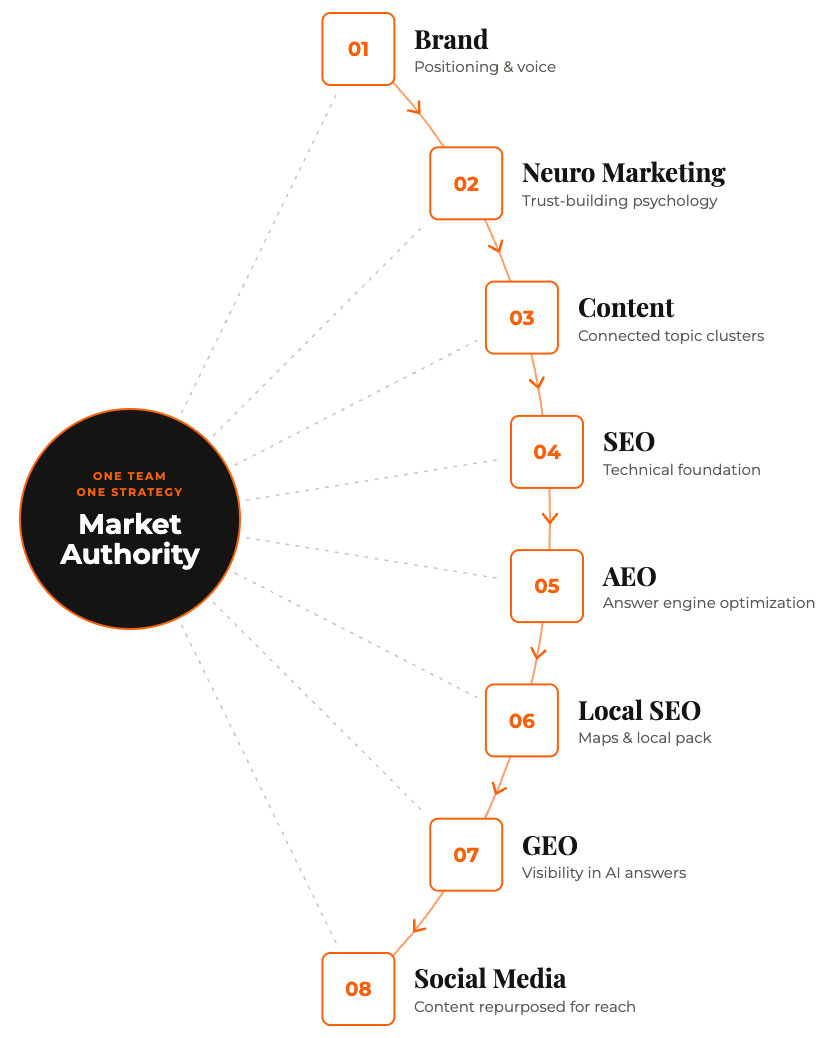
Brand → Neuro Marketing → Content → SEO → AEO → Local SEO → GEO → Social Media
One connected system engineered to make you the authority in your market.
Full-Stack Digital Marketing. One Team. One Strategy.
Maybe this sounds familiar. You’ve hired two or more of these:
A website person. An SEO company. A social media freelancer. Someone running ads. Maybe a nephew who “knows Facebook.”
None of them talk to each other. Separate invoices, different reports. And somewhere along the way, you became the unpaid project manager trying to hold it all together. You try to make sense of it, wondering which part, if any of it, is working.
That’s not a marketing plan. It’s a group chat with no one in charge.
We bring it all under one roof: brand, website, content, search, AI visibility, local, and social. One team, working from one strategy, all aimed at one goal: making you the obvious choice in your market.
Scattered marketing doesn’t compound.
It decays.
Authority works the opposite way. It’s built deliberately, it accumulates, and once you have it a competitor can’t simply outspend you for it. The work you did twelve months ago is still working.
That’s the difference between an expense and an asset.

Why We Don’t “Do SEO”
Every agency now claims to use AI. Most use it to produce generic content at volume, material that mostly clutters the web and gets ignored by readers and search engines alike.
Google has spent several update cycles reshaping results specifically to filter that out. The businesses leaning hardest on it are the ones whose rankings go first.
Used the wrong way, AI doesn’t make you an authority. It makes you invisible.
We use it the way you’d use any other instrument in the shop: one tool inside a system built on real research, real analytics, and strategy that existed before the tool did. It amplifies your voice. It doesn’t replace it.
And we don’t sell SEO on its own for two reasons. First because SEO is just a single tool in a tool box. Second, because SEO no longer solves the problem you have on it’s own anyway. Search is one platform among several now. Your customers are asking ChatGPT. They’re looking at Maps. They’re getting complete answers without ever seeing a list of blue links.
Eight Components. One System.
These aren’t packages or tiers or line items you select from. They’re the working parts of one system, sequenced by dependency — each one requires the ones before it.
Each component reinforces the rest. Brand Alignment shapes the content. Content feeds search, answers, and social. Social and local signals reinforce the data that makes AI systems confident enough to recommend you. It compounds, which is precisely why it isn’t sold in pieces.
What Are the 7 Types of Digital Marketing?
You’ll find a lot of lists like this. Most run: SEO, PPC, content marketing, social media, email, affiliate, influencer. Fine as a glossary. Useless as a plan.
The problem with the list format is that it implies these are seven things you can buy separately, in any order, from anyone. That framing is exactly how businesses end up with a social contract, a separate SEO retainer, and a blog subscription that never mention each other.
Here’s the honest version.
The categories are real, and they are not independent.
SEO without content has nothing to rank. Content without brand alignment sounds like everyone else. Social without content becomes a second job. AEO and GEO don’t function at all unless the structural work underneath them already exists.
So we don’t sell seven types. We build eight components as one system, in an order set by what depends on what:
SEO · PPC · Content Marketing · Social Media · Email · Affiliate · Influencer
Seven things sold separately, in any order, from anyone.
Brand Alignment → Neuro Marketing → Content Marketing → SEO → AEO → Local SEO → GEO → Social Media
Eight components, in an order set by what depends on what.
Brand Alignment first, because everything inherits from it. Social Media last, because it’s fed by everything above. Buy the middle without the ends and you’ve bought motion, not momentum.
What You Actually Own
Six Months In
You have positioning that’s genuinely yours and a content architecture built around it. Not fragments. A structure, with every piece placed on purpose and pointing at the next. That’s the foundation everything after this stands on.
Twelve Months In
That architecture is being cited: by search engines, by AI assistants, in conversations you never had to start. Turn off a paid campaign and the leads it brought stop with it. What’s built here doesn’t turn off. It becomes part of the system, adding to the authority already in place, and compounding into everything built next.
Twenty-Four Months In
A competitor who decides to come after your market has to build what you’ve built. That’s not a checklist they can rush through, it’s eighteen months of work, done in the same order, before they’re standing where you already are. By the time they catch up, you haven’t stood still.
This Is Authority Architecture: One Structure That Keeps Expanding
and you own it all
It sits on your domain, in your voice, under your name. And every piece added to it, a page, a campaign, a new component of the system, doesn’t sit apart from what’s already there. It connects into the structure already built, reinforces it, and becomes something the next piece builds on. Nothing here is a one-off deliverable. It’s Authority Architecture doing exactly what it’s designed to do: one connected structure that keeps expanding every time we add to it.
A Proven Strategic Process
Analysis
We start by digging into your market to find where the real opportunities are. That’s not a keyword list. It’s a full market and competitive analysis: who’s already ranking, who’s being cited by AI systems, and where the authority gaps are that your business is positioned to fill.
Strategy
We build the roadmap. Business objectives get mapped to content targets, authority clusters, and a sequence of concrete action steps. It’s built around your voice, your industry, and the market you’re actually competing in.
Tracking
Then we track it. Every goal gets tied to a number that means something, and every report tells you what’s working, what needs adjusting, and why. This is where the system earns trust, not by promising results up front, but by showing you the evidence as it accumulates.
On Reporting
Impressions, reach, keyword rankings, and AI visibility are activity metrics. They tell you something happened. Lead flow, booked calls, and revenue are business metrics. They tell you what is working an.
Impressions · Reach · Keyword rankings · AI visibility
They tell you something happened.
Lead flow · Booked calls · Revenue
They tell you whether it mattered.
Most agency reports are heavy on the first set, and so are ours. We report what we can actually track: search visibility, keyword rankings, AI citations, and site traffic. We don’t have a window into your booked calls or your revenue. That lives in your CRM, not ours, so we check our numbers against yours. Based on what your business goals are we work to tie them together to get a complete picture.
How to Tell Whether Any Agency Is Worth Paying
Including us. Four questions worth asking anyone who wants a retainer.
Can they explain how the pieces connect?
If they sell SEO and social as separate products and can’t articulate how one feeds the other, they’re selling tasks rather than a system. Tasks are billable forever and never compound.
What are they measuring?
Ask what’s on the monthly report. If it’s impressions, reach, and rankings with no line connecting to revenue, they’re reporting activity. Ask specifically how a number on that report becomes a customer.
Who does the work?
Ask directly. A great many agencies resell offshore execution behind a friendly account manager. Not automatically disqualifying, but you should know, and they should tell you without hesitating.
What happens if you leave?
You should own your site, your content, your accounts, and your data. If any of that stays behind when you go, you weren’t building an asset. You were renting one.
Customer Reviews
“Firelight Interactive has been handling our online marketing and communications presence for years. They are a one-stop-shop for web development, creative ideation, SEO and so much more. Our business would not be where it is today without Firelight. Check them out!”
Bryan S.
|

Google Review
“Working with Firelight Interactive has been a wonderful experience overall. We were pleased with the level of creativity worked into our website and Logo. They were able to take our concept beyond our own ideas, providing a warm yet professional image to our brand. We are also excited to work with his team on suggested SEO enhancements to our online presence. I have also really appreciated the explanation behind the science of Google’s search and ranking systems. Fascinating. Thank you Jason!!”
Nathan L.
|
Google Review
One Conversation.
Then You’ll Know.
Book a call and we’ll look at where your business currently shows up (in search, in AI answers, on Maps) and where it doesn’t. You’ll leave knowing what the gaps are and what closing them would involve.
We review your market, your competitors, and your current visibility, then map what the system would need to do. This call typically takes about 30 minutes.
Nothing.
No pitch deck, no pressure. If we’re not the right fit, we’ll tell you on the call.